Baylee Froerer

Orchestrating a High-Stake Acquisition Discovery
Why this matters: Led a high risk product acquisition facing ambiguity while delivering immediate clarity and direction.
Overview


Rainfocus
Problem Statement & Summary:
My Company, RainFocus, acquired WebEvents Global, an event technology company trusted by enterprise clients with mission-critical, in-progress events. I was the sole UX designer responsible for integrating WebEvents Global’s core sales-driven event tooling into the RainFocus platform.
The goal was to create a new Sales Acceleration module inside RainFocus that unified many workflows, supported multiple personas, respected the technical realities of the acquisition, and reduced friction for both existing WebEvents Global clients and net-new RainFocus customers.
I led discovery, product understanding, UX strategy, and prototyping across four major features, while coordinating closely with a temporary internal Tiger Team that had shipped an MVP under extreme time pressure.
Team:
- VP Platform Strategy
- Tiger team Product Manager
- Product Manager from various RF tools
- Acquisition WebEvents Global Owner
- UX designer (me)
Timeline:
5 week Discovery, 1 week prototype validation

SaAs

Sales Enablement

B2B
Rapid Context Building

The first challenge was speed. I entered a project already in motion, with a Tiger Team that had stitched together an MVP using existing RainFocus features to meet urgent client needs.
I partnered closely with the Product Manager leading the Tiger Team to:
- Understand how four acquired products were mapped to RainFocus features
- Learn where technical shortcuts had been taken for speed
- Identify which decisions were intentional versus reactive
- Document workflows that spanned multiple internal systems and tools
At this stage, there was limited clarity around who the true end users were, how often they used these tools, and where ownership lived across sales, marketing, and event teams. My role was to bring structure to that ambiguity.
Deconstructing Four Products Into Understandable UX Problems

I was responsible for learning and evaluating four complex tools that would normally warrant separate product teams.
Schedule BuilderA sales-driven agenda building tool that allowed AEs (Account Executive, Sales) to curate event schedules on behalf of attendees. I identified core UX challenges around impersonation, visibility, audibility, and trust. Key questions included how admins could see who made changes, how AEs selected attendees, and how this fit into RainFocus’s security model.
Special Interest ActivitiesMini-events inside a main event with layered submission, approval, nomination, and attendance flows. The Tiger Team had creatively combined Sessions, Meetings, Live Tables, Dashboards, Workflows, and Email Programs to ship an MVP. My focus was understanding the mental model of SIA owners and AEs and identifying where the experience broke down due to technical workarounds.
Invite GroupsA capacity-controlled invitation system built on registration codes. I evaluated how non-admin users could safely manage invite lists, track status, and operate independently without exposing them to RainFocus’s complex admin UI.
MeetingsAE-requested and AE-nominated meetings with overlapping mechanics but different ownership and approval models. I focused on unifying these experiences so sales users did not need to understand internal RainFocus distinctions to accomplish their goals.
Across all four, I mapped personas, lifecycle stages, dependencies, and pain points into a single system view.
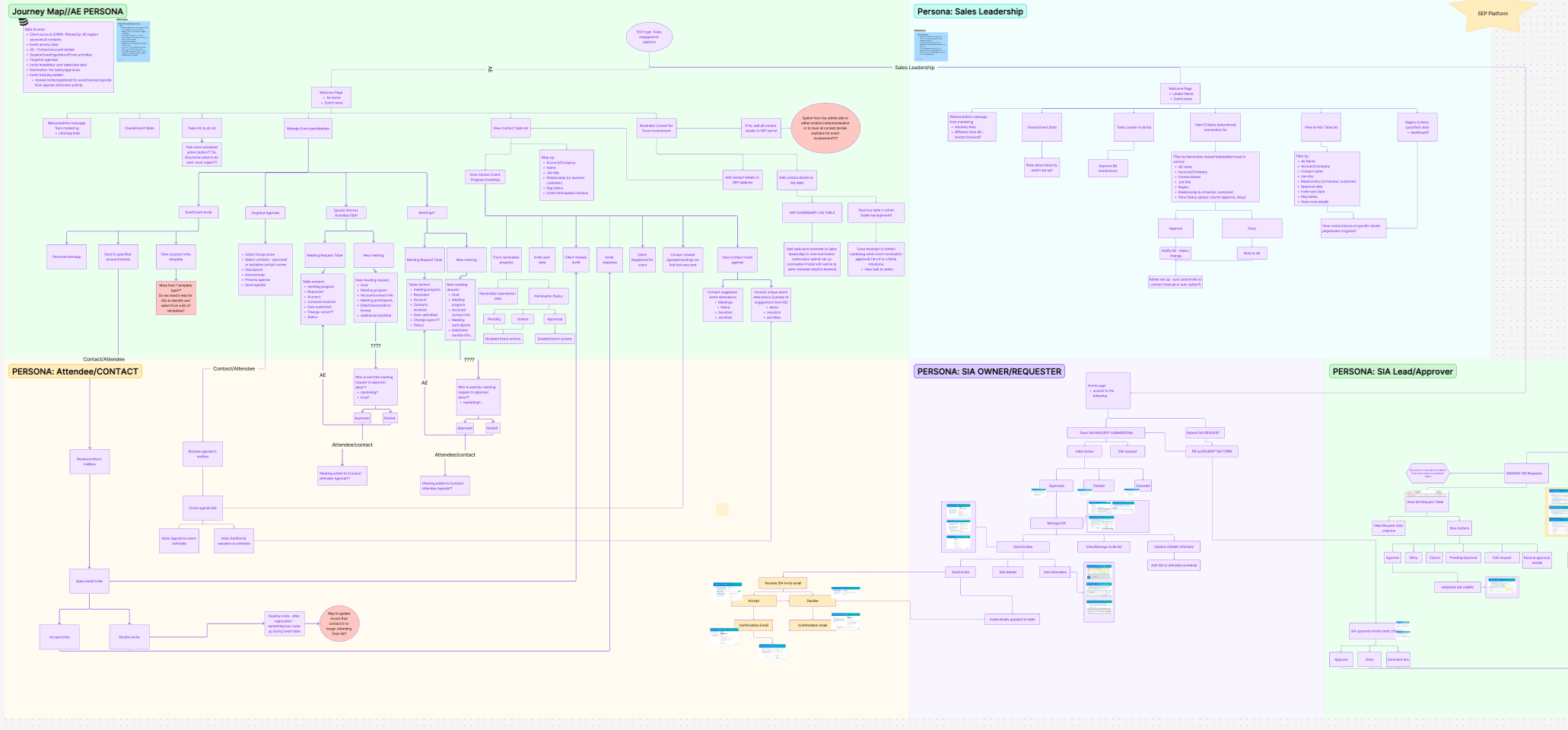
User Journey Mapping
Identifying the Core UX Opportunity

Through discovery, a clear insight emerged. The problem was not individual features. It was fragmentation. WebEvents Global had provided a dedicated AE Portal where sales users completed all event-related tasks in one place. The Tiger Team solution, while functional, forced AEs to jump between systems, workflows, and mental models.
The core UX opportunity was to design toward a unified, task-focused Sales Portal inside RainFocus that:
- Gave AEs a single entry point
- Allowed them to act only on accounts and attendees they owned
- Reduced cognitive load by hiding admin complexity
- Maintained flexibility for varied client use cases
This insight became the north star for all subsequent design work.
Deep Domain Learning From the Acquired Team

To validate assumptions, I met directly with the President and subject matter experts from WebEvents Global. Together, we walked through:
- The original AE portal experience
- Admin configuration and reporting workflows
- How different personas interacted with the system at different stages
- Why clients trusted and depended on this tooling
This step was critical. It allowed me to design with respect for existing user expectations while identifying where RainFocus could exceed the legacy experience rather than simply replicate it.
Prototyping to Drive Alignment & Decision Making

Given the timeline and executive involvement, traditional design cycles were not viable. I leveraged AI-assisted design tools to rapidly produce high-fidelity prototypes for each persona and feature area.
These prototypes served multiple purposes:
- Validated that knowledge transfer from the Tiger Team was accurate
- Made abstract workflows tangible for executives and engineering
- Enabled fast feedback on scope, feasibility, and sequencing
- Anchored conversations around user value instead of technical constraints
What would have taken weeks of iterative wire framing was compressed into days, without sacrificing clarity or intent.
Prototype - Feature: SIA’s - Persona: Requestor
Prototype - Feature: SIA’s - Persona: Owner
Prototype - Feature: SIA’s - Persona: Program Manager
Prototype - Feature: Invite Groups - Persona: Owner
Establishing UX Direction for Productization

The final outcome of my work was not a finished product. It was clarity.
I delivered:
- A unified UX vision for the Sales Acceleration module
- Clear articulation of user personas and their needs
- Identification of which Tiger Team solutions should be hardened, redesigned, or retired
- A recommendation to prioritize end-user experiences first, with admin configuration to follow
This direction gave product and engineering a shared understanding of what needed to be built next and why.
©Baylee Froerer
• 2026 • Remade far too many times to count
Baylee Froerer

Orchestrating a High-Stake Acquisition Discovery
Why this matters: Led a high risk product acquisition facing ambiguity while delivering immediate clarity and direction.
Overview

Rainfocus
Problem Statement & Summary:
My Company, RainFocus, acquired WebEvents Global, an event technology company trusted by enterprise clients with mission-critical, in-progress events. I was the sole UX designer responsible for integrating WebEvents Global’s core sales-driven event tooling into the RainFocus platform.
The goal was to create a new Sales Acceleration module inside RainFocus that unified many workflows, supported multiple personas, respected the technical realities of the acquisition, and reduced friction for both existing WebEvents Global clients and net-new RainFocus customers.
I led discovery, product understanding, UX strategy, and prototyping across four major features, while coordinating closely with a temporary internal Tiger Team that had shipped an MVP under extreme time pressure.
Team:
- VP Platform Strategy
- Tiger team Product Manager
- Product Manager from various RF tools
- Acquisition WebEvents Global Owner
- UX designer (me)
Timeline:
5 week Discovery, 1 week prototype validation
SaAs
Sales Enablement
B2B
Rapid Context Building

The first challenge was speed. I entered a project already in motion, with a Tiger Team that had stitched together an MVP using existing RainFocus features to meet urgent client needs.
I partnered closely with the Product Manager leading the Tiger Team to:
- Understand how four acquired products were mapped to RainFocus features
- Learn where technical shortcuts had been taken for speed
- Identify which decisions were intentional versus reactive
- Document workflows that spanned multiple internal systems and tools
At this stage, there was limited clarity around who the true end users were, how often they used these tools, and where ownership lived across sales, marketing, and event teams. My role was to bring structure to that ambiguity.
Deconstructing Four Products Into Understandable UX Problems

I was responsible for learning and evaluating four complex tools that would normally warrant separate product teams.
Schedule BuilderA sales-driven agenda building tool that allowed AEs (Account Executive, Sales) to curate event schedules on behalf of attendees. I identified core UX challenges around impersonation, visibility, audibility, and trust. Key questions included how admins could see who made changes, how AEs selected attendees, and how this fit into RainFocus’s security model.
Special Interest ActivitiesMini-events inside a main event with layered submission, approval, nomination, and attendance flows. The Tiger Team had creatively combined Sessions, Meetings, Live Tables, Dashboards, Workflows, and Email Programs to ship an MVP. My focus was understanding the mental model of SIA owners and AEs and identifying where the experience broke down due to technical workarounds.
Invite GroupsA capacity-controlled invitation system built on registration codes. I evaluated how non-admin users could safely manage invite lists, track status, and operate independently without exposing them to RainFocus’s complex admin UI.
MeetingsAE-requested and AE-nominated meetings with overlapping mechanics but different ownership and approval models. I focused on unifying these experiences so sales users did not need to understand internal RainFocus distinctions to accomplish their goals.
Across all four, I mapped personas, lifecycle stages, dependencies, and pain points into a single system view.
User Journey Mapping
Identifying the Core UX Opportunity

Through discovery, a clear insight emerged. The problem was not individual features. It was fragmentation. WebEvents Global had provided a dedicated AE Portal where sales users completed all event-related tasks in one place. The Tiger Team solution, while functional, forced AEs to jump between systems, workflows, and mental models.
The core UX opportunity was to design toward a unified, task-focused Sales Portal inside RainFocus that:
- Gave AEs a single entry point
- Allowed them to act only on accounts and attendees they owned
- Reduced cognitive load by hiding admin complexity
- Maintained flexibility for varied client use cases
This insight became the north star for all subsequent design work.
Deep Domain Learning From the Acquired Team

To validate assumptions, I met directly with the President and subject matter experts from WebEvents Global. Together, we walked through:
- The original AE portal experience
- Admin configuration and reporting workflows
- How different personas interacted with the system at different stages
- Why clients trusted and depended on this tooling
This step was critical. It allowed me to design with respect for existing user expectations while identifying where RainFocus could exceed the legacy experience rather than simply replicate it.
Prototyping to Drive Alignment & Decision Making

Given the timeline and executive involvement, traditional design cycles were not viable. I leveraged AI-assisted design tools to rapidly produce high-fidelity prototypes for each persona and feature area.
These prototypes served multiple purposes:
- Validated that knowledge transfer from the Tiger Team was accurate
- Made abstract workflows tangible for executives and engineering
- Enabled fast feedback on scope, feasibility, and sequencing
- Anchored conversations around user value instead of technical constraints
What would have taken weeks of iterative wire framing was compressed into days, without sacrificing clarity or intent.
Prototype - Feature: SIA’s - Persona: Requestor
Prototype - Feature: SIA’s - Persona: Owner
Prototype - Feature: SIA’s - Persona: Program Manager
Prototype - Feature: Invite Groups - Persona: Owner
Establishing UX Direction for Productization

The final outcome of my work was not a finished product. It was clarity.
I delivered:
- A unified UX vision for the Sales Acceleration module
- Clear articulation of user personas and their needs
- Identification of which Tiger Team solutions should be hardened, redesigned, or retired
- A recommendation to prioritize end-user experiences first, with admin configuration to follow
This direction gave product and engineering a shared understanding of what needed to be built next and why.
©Baylee Froerer
• 2026 • Remade far too many times to count

Baylee Froerer

Orchestrating a High-Stake Acquisition Discovery
Why this matters: Led a high risk product acquisition facing ambiguity while delivering immediate clarity and direction.
Overview

Rainfocus
Problem Statement & Summary:
My Company, RainFocus, acquired WebEvents Global, an event technology company trusted by enterprise clients with mission-critical, in-progress events. I was the sole UX designer responsible for integrating WebEvents Global’s core sales-driven event tooling into the RainFocus platform.
The goal was to create a new Sales Acceleration module inside RainFocus that unified many workflows, supported multiple personas, respected the technical realities of the acquisition, and reduced friction for both existing WebEvents Global clients and net-new RainFocus customers.
I led discovery, product understanding, UX strategy, and prototyping across four major features, while coordinating closely with a temporary internal Tiger Team that had shipped an MVP under extreme time pressure.
Team:
- VP Platform Strategy
- Tiger team Product Manager
- Product Manager from various RF tools
- Acquisition WebEvents Global Owner
- UX designer (me)
Timeline:
5 week Discovery, 1 week prototype validation
SaAs
Sales Enablement
B2B
Rapid Context Building

The first challenge was speed. I entered a project already in motion, with a Tiger Team that had stitched together an MVP using existing RainFocus features to meet urgent client needs.
I partnered closely with the Product Manager leading the Tiger Team to:
- Understand how four acquired products were mapped to RainFocus features
- Learn where technical shortcuts had been taken for speed
- Identify which decisions were intentional versus reactive
- Document workflows that spanned multiple internal systems and tools
At this stage, there was limited clarity around who the true end users were, how often they used these tools, and where ownership lived across sales, marketing, and event teams. My role was to bring structure to that ambiguity.
Deconstructing Four Products Into Understandable UX Problems

I was responsible for learning and evaluating four complex tools that would normally warrant separate product teams.
Schedule BuilderA sales-driven agenda building tool that allowed AEs (Account Executive, Sales) to curate event schedules on behalf of attendees. I identified core UX challenges around impersonation, visibility, audibility, and trust. Key questions included how admins could see who made changes, how AEs selected attendees, and how this fit into RainFocus’s security model.
Special Interest ActivitiesMini-events inside a main event with layered submission, approval, nomination, and attendance flows. The Tiger Team had creatively combined Sessions, Meetings, Live Tables, Dashboards, Workflows, and Email Programs to ship an MVP. My focus was understanding the mental model of SIA owners and AEs and identifying where the experience broke down due to technical workarounds.
Invite GroupsA capacity-controlled invitation system built on registration codes. I evaluated how non-admin users could safely manage invite lists, track status, and operate independently without exposing them to RainFocus’s complex admin UI.
MeetingsAE-requested and AE-nominated meetings with overlapping mechanics but different ownership and approval models. I focused on unifying these experiences so sales users did not need to understand internal RainFocus distinctions to accomplish their goals.
Across all four, I mapped personas, lifecycle stages, dependencies, and pain points into a single system view.
User Journey Mapping
Identifying the Core UX Opportunity

Through discovery, a clear insight emerged. The problem was not individual features. It was fragmentation. WebEvents Global had provided a dedicated AE Portal where sales users completed all event-related tasks in one place. The Tiger Team solution, while functional, forced AEs to jump between systems, workflows, and mental models.
The core UX opportunity was to design toward a unified, task-focused Sales Portal inside RainFocus that:
- Gave AEs a single entry point
- Allowed them to act only on accounts and attendees they owned
- Reduced cognitive load by hiding admin complexity
- Maintained flexibility for varied client use cases
This insight became the north star for all subsequent design work.
Deep Domain Learning From the Acquired Team

To validate assumptions, I met directly with the President and subject matter experts from WebEvents Global. Together, we walked through:
- The original AE portal experience
- Admin configuration and reporting workflows
- How different personas interacted with the system at different stages
- Why clients trusted and depended on this tooling
This step was critical. It allowed me to design with respect for existing user expectations while identifying where RainFocus could exceed the legacy experience rather than simply replicate it.
Prototyping to Drive Alignment & Decision Making

Given the timeline and executive involvement, traditional design cycles were not viable. I leveraged AI-assisted design tools to rapidly produce high-fidelity prototypes for each persona and feature area.
These prototypes served multiple purposes:
- Validated that knowledge transfer from the Tiger Team was accurate
- Made abstract workflows tangible for executives and engineering
- Enabled fast feedback on scope, feasibility, and sequencing
- Anchored conversations around user value instead of technical constraints
What would have taken weeks of iterative wire framing was compressed into days, without sacrificing clarity or intent.
Prototype - Feature: SIA’s - Persona: Requestor
Prototype - Feature: SIA’s - Persona: Owner
Prototype - Feature: SIA’s - Persona: Program Manager
Prototype - Feature: Invite Groups - Persona: Owner
Establishing UX Direction for Productization

The final outcome of my work was not a finished product. It was clarity.
I delivered:
- A unified UX vision for the Sales Acceleration module
- Clear articulation of user personas and their needs
- Identification of which Tiger Team solutions should be hardened, redesigned, or retired
- A recommendation to prioritize end-user experiences first, with admin configuration to follow
This direction gave product and engineering a shared understanding of what needed to be built next and why.
©Baylee Froerer
• 2026 • Remade far too many times to count